South Africa is facing a deepening food and nutrition crisis, with millions of households experiencing food insecurity and children continuing to face high rates of stunting. As government develops the National Food and Nutrition Security Plan (NFNSP-2) for 2027–2037, civil society organisations, grassroots groups, academics and provincial representatives have come together to identify shared priorities for the public consultation process.
The workshop, convened by the Union Against Hunger and the Just Transition in the Food System Network, with support from the Institute for Economic Justice and the DSTI-NRF Centre of Excellence in Food Security, brought together around 70 participants from across all nine provinces. Participants agreed on six key priorities that should shape the new plan and its implementation.
What should the new plan prioritise?
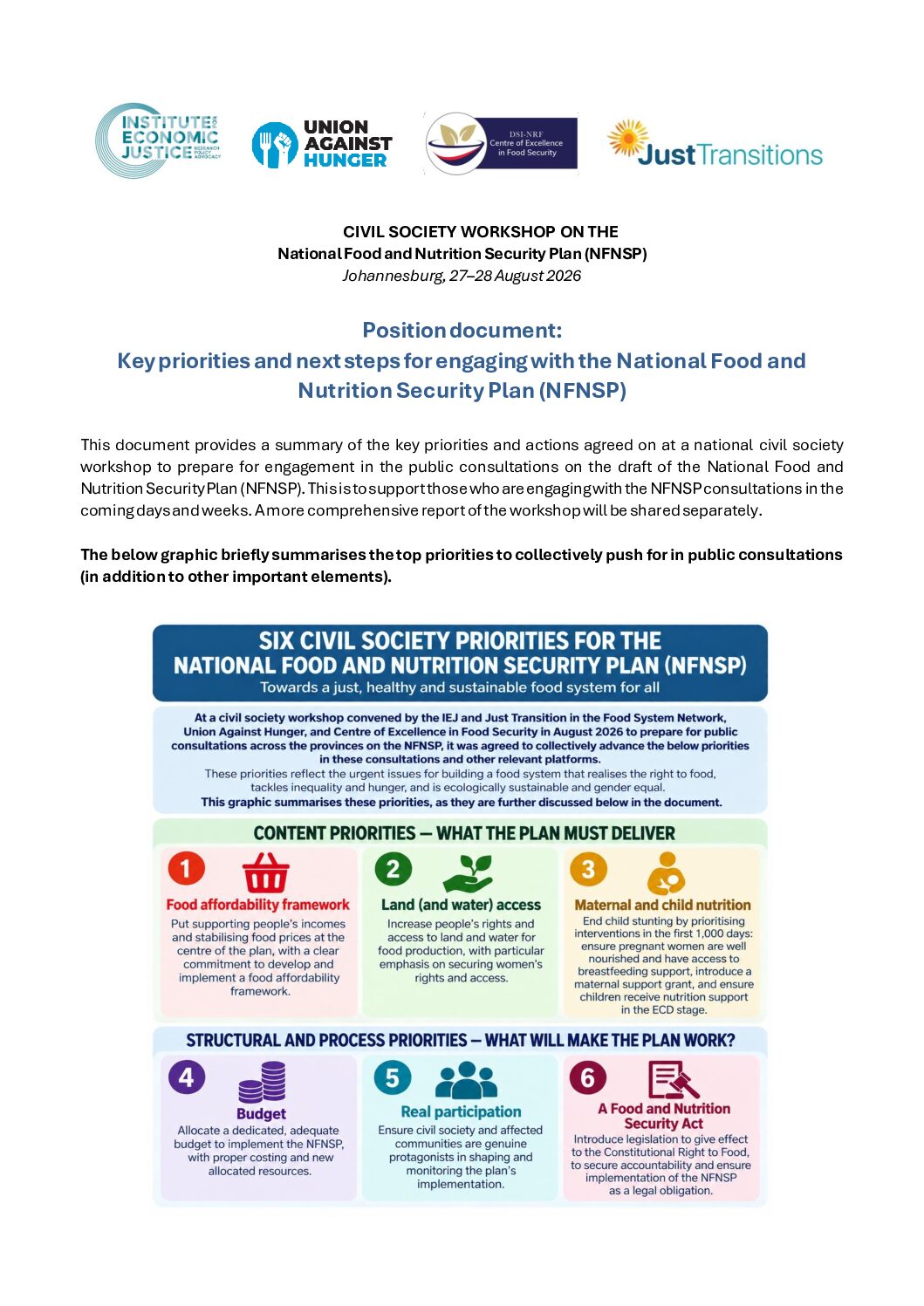
The workshop identified three content priorities:
- Food affordability: The NFNSP must include clear commitments to address food prices, household incomes and the affordability of a healthy diet.
- Land and water access: More people, particularly women and small-scale producers, need meaningful access to land and the water and infrastructure required to produce food.
- Maternal and child nutrition: The first 1,000 days, from conception to a child’s second birthday, must be prioritised through stronger nutrition support for pregnant women, mothers and young children.
Three structural priorities were also identified to ensure the plan can be effectively implemented:
- An adequate budget: The NFNSP must be properly costed and supported by dedicated resources. The failure to adequately resource the previous plan must not be repeated.
- Meaningful participation: Civil society and affected communities must have an ongoing role in shaping, implementing and monitoring the plan, rather than being treated as once-off consultation participants.
- A Food and Nutrition Security Act: Legislation is needed to give effect to the constitutional right to food and strengthen accountability for implementation.
Beyond the six priorities
Participants also highlighted the need for stronger gender and disability inclusion, climate resilience, support for informal traders and small-scale farmers, improved nutrition programmes for vulnerable groups, and greater community participation and accountability.
The six priorities provide a shared minimum platform for civil society engagement in the provincial consultations. Organisations remain free to raise additional issues relevant to their communities and constituencies.
What happens next?
Government’s provincial consultations are taking place from September 2026, leading to a National Indaba in November 2026. Civil society organisations and grassroots movements are encouraged to participate, bring affected communities into the process and coordinate around shared demands.
The workshop also emphasised that the consultation process is only one part of a longer struggle to address hunger and advance the right to food. Sustained organising, advocacy and monitoring will be needed to ensure that the final NFNSP-2 is properly resourced and implemented.